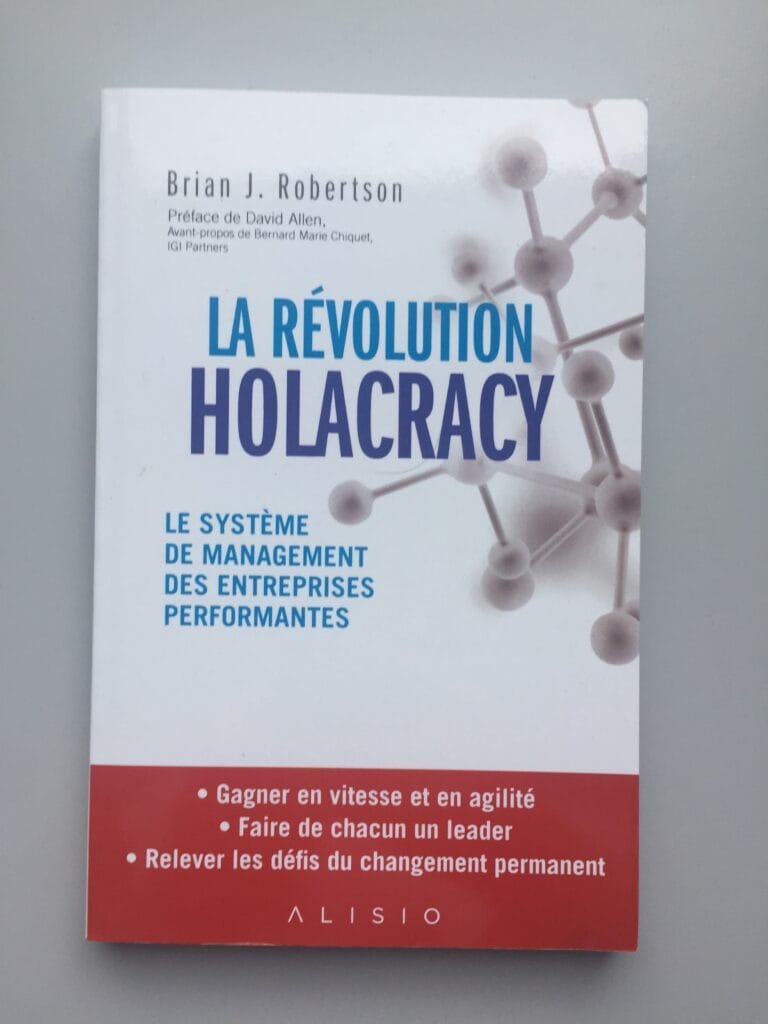
Brian Robertson, a former entrepreneur who now works with HolacracyOne, is the author of the book Holacracy. It presents a method of corporate governance that goes against the traditional hierarchical pyramid we are familiar with. The idea starts from the observation that the person at the very top of the organization is often the one farthest removed from the problems faced by those at the bottom. Moreover, in a company, it is not only your manager who depends on your work—your colleagues and clients do as well. This makes the case for a different organizational model.
To achieve this, Holacracy proposes a deep change: assigning roles rather than people to tasks. It introduces the concept of circles, where the company is divided into several circles—for example, marketing. Depending on the needs of the company, these circles can be divided into sub-circles, and so on. Within each circle, there are defined roles. In our marketing example, roles might include social media management or advertising campaigns. Each circle also includes the notion of links. For instance, the marketing circle may consult the “website maintenance” role to avoid launching an advertising campaign while the site is under maintenance. There are therefore no departments in the traditional sense, but rather a network of circles. Roles within circles can evolve through governance meetings.
“Holacracy does not try to improve people, make them more compassionate, or expand their consciousness. Nor does it ask them to create a specific culture or behave toward others in a particular way. But precisely because it does not try to change people or culture, it allows personal and cultural development to occur more naturally.”
The Holacracy approach contrasts with agile frameworks such as Scrum. In Scrum, work is organized into sprints of fixed duration, usually two, three, or four weeks. With Holacracy, it is different: there are actions but no fixed deadlines. The assumption is that nothing can be fully predicted in advance and that priorities can change. Something that was initially planned to be done first may end up being done second because a more important issue arises in the meantime.
The Holacracy process emphasizes data rather than opinions. This is particularly true during circle meetings. Meetings follow a very structured format, which can sometimes appear almost authoritarian when described by the author. In reality, Robertson insists that these rules must not be broken. It is similar to a team sport: the rules must be respected for the game to run smoothly. The structure of meetings is fairly similar whether they are operational meetings or governance meetings. The author’s process aims to resolve problems quickly and, if possible, at their source—thanks in part to the concept of roles. At no point is consensus sought. According to the author, consensus does not effectively resolve every tension.
In practice, the reaction round during meetings is used to gather each participant’s perspective, rather than their opinions about the perspectives of others. The person who raised the topic is ultimately responsible for making the decision, taking into account the different viewpoints expressed by the members of the circle.